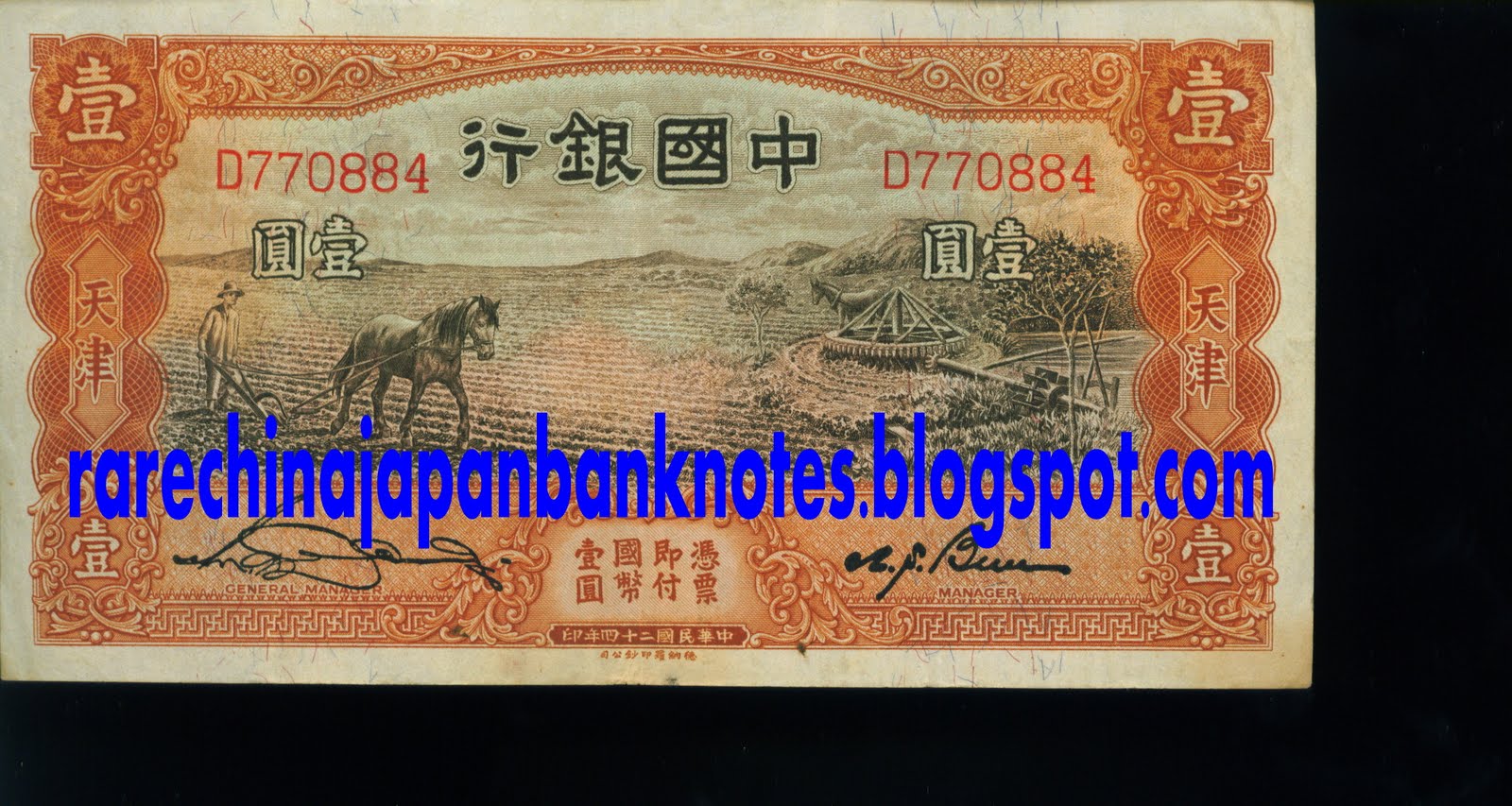
AGRICULTURE IN MEDIEVAL CHINA
Yokuhama 1866 banknote History,american rare banknotes,Central bank of Western India,hansatsu,indian banknotes,japan banknotes,rare japan banknotes,world rare banknotes,yokohama specie banknotes,Cultural history of Japan china 30k old,perry GOLD MEDAL,TEINSTEN banknotes,Yokuhama banknote 1866 History,hansatsu,Nippon Ginko history,ancient scripts of china,Islamic China banknotes,china cloth banknotes,china banknotes,samurai,WRITING BOOK ON JAPANESE,CHINESE,RUSSIAN,GERMAN BANKING IN EAST ASIA
Sunday, October 2, 2011
AGRICULTURE IN MEDIEVAL CHINA
SHANGHAI 1926 Value changed from 5 yuan to 4 yuan RARE
chinese Overprints showing on china banknote usage by many different banks,china banknotes,japan banknotes,YOKUHAMA BANKNOTE 1866 25 $,
Ovpts showing its usage by many diff banks
Sunday, September 25, 2011
Yuan Hengli Money Shop, 3 diao
3 strings (diao) payable in value 10 struck copper coins
This is an unissued exchange note of 元亨利 Yuan Hengli Money Shop.
Top inscription: 歷邑東北鄉李官莊 @ me at niponginko@gmail.com
Printed obviously in the early years of the Republic.
Denomination is given as 3 strings payable in "value 10" struck copper coins at the rate "98". The Inscription in green color given at the bottom of the note says
"Altogether 147 pc. "value 10" coins" (計銅元壹百四十七枚) what exactly fits to the method of the calculation of the cash coins used in
yokuhoma banknote,japan western india banknotes 1866

japan banknotes,china banknotes,ancient coins,world banknotes,ancient culture china japan,ancient scripts of china,buddhism,buddha coins,japan culture,yokuhoma banknote,japan western india banknotes 1866,
HEIAN SCRIPT 794 AD ONWARDS

The Heian period was preceded by the Nara period and began in 794 after the movement of the capital of Japan to Heian-kyō (present day Kyōto), by the 50th emperor, Emperor Kammu. It is considered a high point in Japanese culture that later generations have always admired. The period is also noted for the rise of the samurai class, which would eventually take power and start the feudal period of Japan.
Nominally, sovereignty lay in the emperor but in fact power was wielded by the Fujiwara nobility. However, to protect their interests in the provinces, the Fujiwara and other noble families required guards, police and soldiers. The warrior class made steady gains throughout the Heian period. As early as 939, Taira no Masakado threatened the authority of the central government, leading an uprising in the eastern province of Hitachi, and almost simultaneously, Fujiwara no Sumitomo rebelled in the west. Still, military takeover was centuries away, when much of the strength of the government would lie within the private armies of the shogunate.
The entry of the warrior class into court influence was a result of the Hōgen Rebellion. At this time Taira no Kiyomori revived the Fujiwara practices by placing his grandson on the throne to rule Japan by regency. Their clan (Taira clan) would not be overthrown until after the Gempei War, which marked the start of the shogunate. The Kamakura period began in 1185 when Minamoto no Yoritomo seized power from the emperors and established a bakufu, the Kamakura shogunate, in Kamakura.
Friday, September 23, 2011
GOLD COINS Ying Yuan Chu State of the Warring States

According experts at the Jiangsu Bureau of Cultural Relics, these ‘Ying Yuan’ were unearthed at the Friendship village in Liuzhuang township in the City of Dafeng. The coins vary in size but have consistent thickness, weighing 175 grams. The characters ‘Ying Yuan’ are stamped on the coin surface using the square seal script calligraphic style. These coins were circulated and widely used in the Chu state during the period of the Warring States.
Ying Yuan - from the Chu State during the period of the Warring States
A specially appointed team of experts by the Jiangsu province Bureau of Cultural Relics, the place of origin of the excavated coins is clear. These widely circulated Ying Yuang had been chiselled and engraved, and provides important value for the research of coins of the Warring States period as well as insight into how “Ying Yuan†were used. Previously in 1982, “Ying Yuan†were unearthed in the county of Xuyi in Jiangsu Province. Those were still intact in rectangular blocks not having been cut or circulated.
Ying Yuan were used as a weighing currency. It comes in two shapes, one is in rectangular or square gold block and the other is a flat circular gold piece. The former was more common. It was used according to need and the gold block or piece would be cut into fragments. Then through specific weighing scales they were weighed and traded accordingly. Consequently, the majority of excavated coins from the Chu period were in fragments and their size and weight varies greatly. So through the circulated “Ying Yuanâ€, the cut marks are easily evident.@china news
Saturday, July 23, 2011
日本銀行 Nippon Ginko history
Bank of Japan was founded after the Meiji Restoration. Prior to the Restoration, Japan's feudal fiefs all issued their own money, hansatsu, in an array of incompatible denominations, but the New Currency Act of Meiji 4 (1871) did away with these and established the yen as the new decimal currency, which had parity with the Mexican silver dollar.The former han (fiefs) became prefectures and their mints became private chartered banks which, however, initially retained the right to print money. For a time both the central government and these so-called national banks issued money. A period of unanticipated consequences was ended when the Bank of Japan was founded in Meiji 15 1882 after a Belgian model. It has since been partly privately owned its stock is traded over the counter, hence the stock number. A number of modifications based on other national banks were encompassed within the regulations under which the bank was founded.The institution was given a monopoly on controlling the money supply in 1884, but it would be another 20 years before the previously issued notes were retired.

